

Cost, Budgeting & Developer Math, How To, Pool Waterline, Specs, Materials & Technical Decisions, Technical
Pool Square Footage Calculator

May
You’ll need a few simple tools to get the most accurate pool measurements:
- A measuring tape – could be digital or laser.
- Pen and paper to write down the measurements.
- A calculator.
Calculating Your Pool’s Square Footage and Required Tile Quantity for Your Project
Knowing the square footage of a swimming pool is essential when determining how many tiles you will need to purchase. Therefore, use the information below to estimate the total square footage of your swimming pool’s interior.
Although this formula provides a good guideline for determining the number of tiles required to finish a pool, it’s important to note that most pools have round corners and steps, making it an approximate calculation. Hence, we suggest rounding up the measurements and adding an additional 5-8% more tiles to account for waste.
To ensure that you have enough tiles for your project and avoid running out towards the end, it’s critical to obtain an accurate estimate and account for any additional tiles required. Additionally, by accounting for extra tiles, you can accommodate any unexpected issues or mistakes that may arise during the tiling process. Consequently, this practice helps in ensuring a smooth and uninterrupted completion of your project
The formula is as follows:
(L x W) + (L x Avg Depth x 2) + (W x shallow depth) + (W x deep depth) = Total square footage of surface area of all the pool sides and bottom.
To determine the average depth in a pool where the bottom slopes are: Measure the shallow end and measure the deep end. Add them together and divide by 2. This is the average depth of your pool.
Below is an example using a 16′ x 32′ pool with a Shallow depth of 4′, a deep depth of 8′, and an average depth of 6′ feet.
 L x W = (32 x 16) = 512
L x Avg. Depth x 2 = (32 x 6 x 2) = 384
W x Shallow Depth = (16 x 4) = 64
W x Deep Depth = (16 x 8) = 128
512 sqft for the pool floor + 384 sqft (the two long sides) + 64 sqft (shallow side) + 128 sqft (deep side) = 1088 SQFT.
Calculating the Square Footage of Your Swimming Pool’s Waterline
To calculate the square footage of the waterline of your swimming pool, you need to measure the pool’s perimeter at the waterline and the height of the waterline. Follow these steps:
1 – Measure the perimeter of the pool at the waterline using a tape measure. You can follow the steps in the section below to calculate the perimeter.
2 – To calculate the height of the waterline in your pool, measure the distance from the bottom of the coping to the point just below where the water meets the wall at its highest point. To ensure the appropriate water level of your pool, you can use the skimmer as a guide. Ideally, the water level should be maintained between one-third to one-half of the skimmer opening for optimal performance. This is because the skimmer functions best when it’s covered with pool water halfway.
Typically, homeowners choose to tile from the coping to a few inches below it, or they use the tile’s width multiplied by the perimeter to come up with the sqft for their waterline materials.

3 – Multiply the perimeter by the height to get the square footage of the waterline. For example, if the perimeter of your pool at the waterline is 80 feet and the height of the waterline is 1.5 feet, then the square footage of the waterline would be 120 square feet (80 x 1.5 = 120).
Determining the Perimeter of Your Swimming Pool
To calculate the perimeter of a swimming pool, you need to measure the length and width of the pool at the waterline. The perimeter is the distance around the pool’s edge.
Follow these steps to calculate the swimming pool perimeter:
1 – Measure the length and width of the pool at the waterline using a tape measure. Make sure to measure the longest parts of the pool to get the most accurate measurements.
2 – Add the length and width together to get the total distance across the pool.
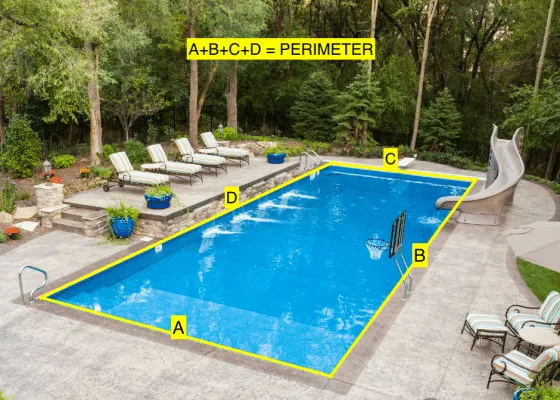
3 – Multiply the total distance across the pool (A+B) x 2, for example, to get the distance around the pool’s perimeter. This is because the pool has two long sides and two short sides.
4 – If the pool has a complex shape or irregular edges, you may need to measure each section separately and add them together to get the total perimeter.

For example, if your pool is 30 feet long and 20 feet wide at the waterline, the total distance across the pool is 50 feet (30 + 20 = 50). Multiplying 50 by 2 gives you a perimeter of 100 feet.
It’s important to note that the square footage of the waterline determines the amount of tile or other decorative material needed for the pool’s waterline. In contrast, it’s different from the total square footage of the pool, which, in turn, includes the area of the pool’s bottom and walls. Consequently, this total square footage is used for determining the amount of material needed for resurfacing or replastering the pool. Therefore, understanding these distinctions is crucial for accurately estimating the materials required for various aspects of pool maintenance and renovation.
Disclaimer
Please note that the information provided by our swimming pool square footage calculator tool is intended to serve as a general guideline only. Although we have taken every effort to ensure the accuracy of the information provided, we cannot guarantee its correctness, completeness, or suitability for any specific purpose.
Furthermore, by using our swimming pool size calculator, you acknowledge that the information provided is not a substitute for professional advice. Consequently, pooltile.ca is not liable for any losses resulting from the use of this tool. In addition, for precise measurements and calculations, we recommend consulting with a qualified contractor or pool builder to obtain the takeoffs and other required measurements.
In summary, while the calculator tool can be a helpful resource, it should not replace the expertise and accuracy that professional consultation can provide. Therefore, for optimal results and to ensure all measurements meet your specific needs, please seek the guidance of experienced professionals in the field.


This article makes me wonder about the importance of accurately knowing your pool’s size. Does it affect chemical dosing or filtration efficiency? I’d love to learn more about how pool size impacts maintenance and water quality.
Thank you for your question! Yes, accurately knowing your pool’s size is crucial. It affects chemical dosing—ensuring the water is clean and safe—and filtration efficiency, which keeps the water clear. Miscalculations can lead to under or overdosing chemicals and inefficient filtration. Accurate measurements help maintain water quality and reduce maintenance issues. If you have more questions, feel free to ask!
I am looking at doing the water line only also there is a hot tub that is 7.2 feet across and the outside diameter is 30. I was looking at you 90 degree tile for the spillway from the hot tub to the pool and around the skimmers (2). Can you only buy them buy the case? And is this a good idea?
Hi Kevin,
That sounds like a great project! The 90-degree corner tile is a perfect choice for the spillway from the hot tub to the pool and around the two skimmers.
You can purchase them by the box (24.6 ln. ft. per box). And yes—this is definitely a great idea. It’ll create a clean, seamless finish and elevate the whole look.
Let us know if you need help calculating quantities or placing the order.